

We recommend you check this page frequently for any future updates. Last Updated on 2/09/2026.
This article reflects official information available on that date.
Introduction
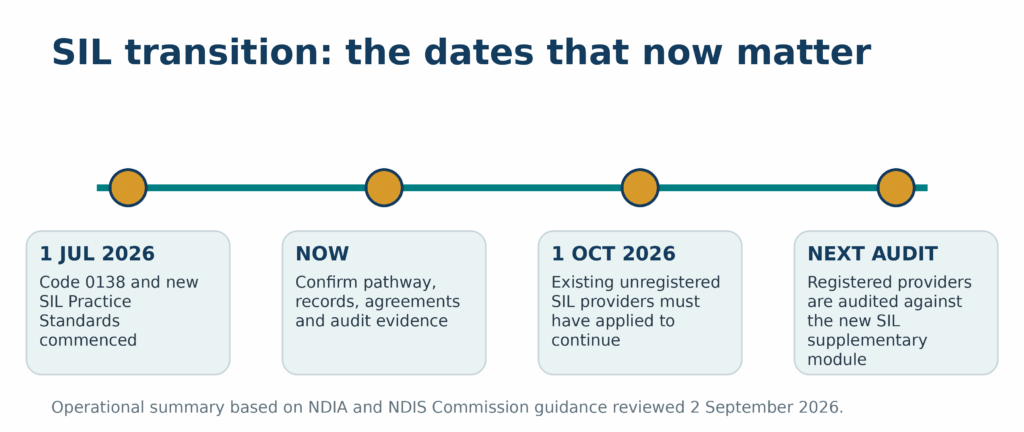
The NDIS provider environment changed materially on 1 July 2026. A new NDIS Pricing Schedule and Support Catalogue now operate together, SIL providers must use registration group and claim code 0138, and a new supplementary module of SIL Practice Standards applies.
The immediate deadline is 1 October 2026. Existing unregistered providers that were already delivering SIL before 1 July 2026 must submit a valid registration application for 0138 by that date if they want to continue delivering SIL under the transition pathway while their application is assessed.
Separately, Parliament passed the National Disability Insurance Scheme Amendment (Securing the NDIS for Future Generations) Bill 2026 on 19 August 2026, and it received assent on 20 August 2026. Some changes are already in effect, while others will be implemented progressively. Providers should distinguish confirmed current obligations from reforms that still require further implementation guidance.
This updated guide explains the current SIL registration and claiming position, the new audit expectations, and the pricing information providers should verify before invoicing.
If You Deliver SIL: Act on These Five Points Now
- Confirm whether your service meets the NDIS Commission definition of SIL and identify the transition pathway that applies to your current registration status.
- Check that registration group 0138 appears on your certificate, or submit a valid 0138 application by 1 October 2026 if you are an eligible existing unregistered SIL provider.
- Use 0138 for SIL supports delivered from 1 July 2026. Use 0115 only for SIL supports delivered before 1 July 2026.
- Align policies, worker training, house-level practices, service agreements and evidence with the four new SIL Practice Standards.
- Use the current Pricing Schedule and Support Catalogue together, and obtain participant agreement before changing prices in an existing service agreement.
What Is the NDIS Pricing Schedule — and Why Is It Different This Year?
In previous years, the NDIA published the Pricing Arrangements and Price Limits (PAPL) — a document that set both the maximum prices for supports and the rules for how additional claiming types (such as travel, cancellations and non-face-to-face time) applied to each item. An accompanying Excel Support Catalogue listed every line item with Y/N flags for each claiming type.
For 2026–27, the PAPL has been replaced by an NDIS Pricing Schedule. Since the original article was published, Parliament passed the Securing the NDIS for Future Generations Bill on 19 August 2026 and it received assent on 20 August. The new laws include a mechanism for the Minister to make pricing determinations, informed by NDIA advice. Providers should continue to use the current published Pricing Schedule and Support Catalogue and monitor implementation updates.
The NDIA describes the current Pricing Schedule as guidance on appropriate and reasonable maximum prices. It must be read with the Support Catalogue. A provider must discuss proposed changes to an existing service agreement with the participant, and the participant must agree before the changes are made.
Important update since the original publication:
- The NDIA has now published the NDIS Support Catalogue 2026–27 in XLSX format. It lists available supports, prices and relevant claim-type guidance, including non-face-to-face support, travel, irregular SIL supports, short-notice cancellations and requested reports.
- The Pricing Schedule has also been updated since its original publication. Version 1.2, published on 22 July 2026, corrected line items and added clarification about provisional psychology claiming. Always use the latest version available from the NDIA.
Group 1: Labour Supports
Schedule 1 — Disability Support Workers (DSW)
The detailed claim-type position should now be checked in the 2026–27 Support Catalogue rather than inferred from the Pricing Schedule alone. Providers should map each support item used in their billing system to the current Catalogue and retain evidence supporting the claim type and service delivered.
Beyond the claiming rules, two structural changes affect Schedule 1:
- Short Term Accommodation (STA) has been split. Support hours now sit under dedicated DSW line items in Schedule 1. The accommodation cost is now billed separately under Schedule 2 as a day rate ($162.85/day nationally). The old all-in-one STA item numbers no longer apply, and service agreements and billing systems must be updated to reflect the split. Note: the NDIA has reverted the name back to STA after briefly calling it Short Term Respite in 2025-26.
- SIL is now a separately defined, mandatory registration class: 0138 Assistance with supported independent living. Existing unregistered SIL providers that were delivering SIL before 1 July 2026 may continue during assessment only if they submit a valid application by 1 October 2026 and meet the transition requirements. New providers must follow the pathway applicable to them and should not begin delivering SIL unless permitted.
Supported Independent Living: The 2026 Registration and Audit Changes
Does your service meet the SIL definition?
The NDIS Commission describes SIL as a package of home and living support for a person with higher support needs who requires support at all times, or for most of the day. The assistance supports or supervises daily life tasks so the participant can live as autonomously as possible and access the community, with the provider managing and delivering the package of supports.
It is not SIL where a person receives only a few hours of support a day or week, or where the participant chooses and manages their own workers, including directing, planning and rostering them. Providers should assess the substance of the arrangement, not only the historical item number or the label used in a service agreement.
Which transition pathway applies?
- Existing registered provider with 0115 and delivering SIL before 1 July 2026: the Commission’s transition pathway provides for registration to be varied to include 0138. Check the new certificate, apply the SIL Practice Standards now and prepare for assessment against them at the next mid-term or renewal audit.
- Existing unregistered provider delivering SIL before 1 July 2026: submit a valid 0138 registration application and any other relevant registration groups before 1 October 2026. The pathway includes a certification audit. If the application is lodged in time, the provider may continue delivering SIL while it is assessed.
- Provider not previously delivering SIL, or provider outside an eligible transition pathway: follow the specific Commission pathway and obtain registration before delivering supports that require mandatory registration. Do not assume the 1 October concession applies.
SIL claiming from 1 July 2026
- Supports delivered before 1 July 2026: use 0115 — Assistance with daily life tasks in a group or shared living arrangement.
- Supports delivered from 1 July 2026: use 0138 — Assistance with Supported Independent Living.
- Plan managers may pay post-1 July SIL invoices only within the eligibility settings published by the NDIA. Providers are encouraged to include their registration number or application number on invoices.
- An existing unregistered SIL provider that does not apply by 1 October 2026 can claim only for services delivered up to 30 September 2026 under the published transition settings.
The Four New SIL Practice Standards

Supported decision-making: Participants are supported to make genuine decisions about their home, daily life, supports and goals using accessible information, their preferred communication methods and chosen decision supporters.
Safeguarding: Providers identify, assess and respond to harm, bullying and conflict in the home using person-centred, trauma-informed approaches while respecting dignity of risk.
Practice governance: Governance and workforce systems must translate into consistent practice. Workers need appropriate training, competency assessment, supervision and guidance in rights-based and evidence-informed practice.
Agreements about tenancy, housing and support arrangements: Tenancy and support agreements must be clear, accessible and separate. Providers must manage conflicts of interest, protect housing stability and support participants to understand and exercise housing and service choices.
Minimum evidence to review before audit
- Policies and procedures for supported decision-making, dignity of risk, safeguarding, conflict and bullying, practice governance, worker development, emergency planning and tenancy/support separation.
- Participant-level evidence showing accessible communication, choice about home and co-tenants, involvement in risk decisions, safeguards, goals and feedback.
- Worker induction, training, refresher training, competency assessment, supervision and practice-observation records.
- Separate tenancy and service agreements where the provider supplies both housing and SIL, together with accessible explanations, conflict-of-interest controls, exit and vacancy processes, visitor arrangements and access to advocacy.
- House-level incident, risk, emergency, continuity and improvement records that show the system works consistently across workers and shifts.
Schedule 2 — Accommodation & Capital Costs
The structural split of STA means that accommodation costs are now a standalone day-rate item under Schedule 2 ($162.85/day nationally for participant accommodation and $162.85/day for support worker accommodation). These are new items — there is no direct equivalent in 2025-26 on a standalone basis. Centre Capital Costs and Medium Term Accommodation (MTA) are otherwise unchanged.
Schedule 3 — Nursing & Other Labour Supports
For nursing supports, use the current Support Catalogue to verify the claim types applying to each item. Do not treat the absence of claim-type columns in the Pricing Schedule as permission to claim, or as a prohibition, without checking the Catalogue.
Rates have increased: Enrolled Nurse weekday daytime $103.44/hr, Registered Nurse $128.05/hr, Clinical Nurse Consultant $175.18/hr, and Nurse Practitioner $183.15/hr nationally.
Group 2: Allied Health
Schedule 4 — Therapeutic Supports
This is where the most significant structural change in the entire Pricing Schedule sits. The old portal claim-type selection — where providers chose NFF, Travel, Cancellation or Reports as a claim type when submitting — has been completely removed for allied health. It no longer exists.
In its place, allied health disciplines generally have a direct-service item plus five suffix-coded items. The suffix is appended to the base item number:
- _CA — Cancellation, at the full direct service rate
- _NF — Non-Face-to-Face, at the full direct service rate
- _PT — Provider Travel, at exactly 50% of the direct service rate
- _RR — NDIA Requested Reports, at the full direct service rate
- _TH — Telehealth, at the full direct service rate (brand new in 2026-27)
Providers should confirm the exact items available for their discipline in the latest Schedule and Catalogue, update billing software and select the correct direct or suffix-coded support item for the service actually delivered.
Key rate changes in Schedule 4:
- Psychologist: increased to $252.99/hr (from $232.99) — the rate was below the external benchmark range
- Dietitian: decreased to $178.99/hr (from $188.99) — the rate was above the benchmark range
- Exercise Physiologist: decreased to $161.99/hr (from $166.99)
- Orientation & Mobility Specialist: now a standalone discipline with its own item numbers at $156.16/hr — previously claimed under Other Professional
For telehealth, non-face-to-face activities and other suffix-coded claims, apply the description and claim guidance in the current Schedule and Catalogue to the activity actually delivered, and keep records that substantiate the selected item.
Schedule 5 — Early Childhood Supports
The same direct-service and suffix-coded structure applies across Early Childhood Intervention disciplines. Providers should verify the exact item and rate for their discipline in the current Schedule and Catalogue. Telehealth (_TH) is new in 2026–27.
Two additional changes apply specifically to Schedule 5:
- Early Childhood Teacher/Educator is a new discipline in 2026–27. Confirm the current base and suffix-coded item numbers and rates in the latest Schedule and Catalogue before billing.
- The age limit extension to 9 years (introduced 1 July 2025) carries forward unchanged.
Group 3: Coordination & Management
Schedule 6 — Support Coordination
Support Coordination providers should now verify claim types against the 2026–27 Support Catalogue and use the Schedule and Catalogue together. Historical 2025–26 flags should not be assumed to continue without checking the current item.
Rate changes: Level 1 Support Connection has increased marginally to $80.06/hr (from $78.12). Level 2 Coordination of Supports remains frozen at $100.14/hr and Level 3 Specialist Support Coordination at $190.54/hr — both frozen for the seventh consecutive year. The NDIA has flagged a broader review of the support coordination model.
Schedule 7 — Plan Management
The monthly Plan Management fee remains frozen for the seventh consecutive year at $104.45/month. No claiming rule changes apply to this schedule — it is a fixed monthly fee with no activity-based claiming flags. The NDIA has recommended a future review of whether the flat monthly fee model remains appropriate as the market evolves.
Group 4: Non-Labour / Products / Quotable
Schedule 9 — Supports Without Specified Prices
Two items previously sitting in the broader non-priced group have moved into Schedule 4 (Therapeutic Supports) in 2026-27: 15_047 (Selection/Manufacture of Individualised Technology) and 15_300 (AT Mentoring). Both now carry the full six suffix items. No other claiming rule changes apply to AT, consumables, home modifications or equipment items.
Schedules 8, 10 & 11 — Notional Unit Priced Items, Quotable Supports, Isolated Towns
No claiming rule changes for these schedules. Notional items remain at $1.00. Quotable supports still require an approved quote before delivery. Schedule 11 remains a pricing modifier list only.
What This Means for Providers — Current Verification Position
| Provider Group | Current Source to Use | What to Verify Now |
|---|---|---|
| DSW and nursing | 2026–27 Pricing Schedule + Support Catalogue | Item number, price, permitted claim type, service agreement and evidence for the claim. |
| Allied Health and ECI | Schedule 4 or 5 + Support Catalogue | Correct direct or suffix-coded item (_CA, _NF, _PT, _RR or _TH), applicable rate and records. |
| Support Coordination | Schedule 6 + Support Catalogue | Current item and claim-type guidance; do not rely on 2025–26 flags. |
| Plan Management | Schedule 7 + current NDIA guidance | Current monthly item/rate and eligibility; no activity-based suffix selection. |
| Supported Independent Living | NDIA SIL claiming guidance + Commission transition pathway | 0138 for supports from 1 July 2026; registration/application status; 1 October deadline; Practice Standards and audit evidence. |
What the Broader 2026 NDIS Reform Means Right Now
The Securing the NDIS for Future Generations legislation has now passed and received assent. The NDIA says changes cover areas including access, planning, funding, pricing, plan management and provider operations. Some measures are in effect while others require staged implementation.
- Do not tell participants that their existing plan or supports automatically changed because the legislation passed. The NDIA’s current message is that people can continue using their plan and supports as usual unless advised that a change affects them.
- Separate current operational requirements — such as the SIL registration, claiming and Practice Standards changes — from future reforms that require rules, systems or later commencement.
- Monitor NDIA and NDIS Commission implementation pages and update contracts, systems, policies, worker instructions and participant communications only when the applicable requirement and commencement date are confirmed.
- New framework planning remains scheduled to roll out from 1 April 2027, subject to further implementation information.
How ISO Consulting Services Can Help
At ISO Consulting Services, we work with NDIS providers across Australia to stay ahead of pricing changes, maintain compliance, and prepare for audits with confidence. Whether you need help interpreting the 2026-27 Pricing Schedule, updating your service agreements, preparing for the new SIL registration requirements, or aligning your billing systems with the new suffix item structure, our team is ready to assist. We can also assess your readiness against the four SIL Practice Standards, identify evidence gaps, support registration and certification-audit preparation, and align participant, house-level and workforce records with the new requirements.
Our ISO+™ NDIS platform provides an all-in-one compliance management system built specifically for NDIS providers, with linked policies, registers, incident tracking, audit tools, and real-time visibility across your operations.
Don’t wait for a rejected claim or audit finding to expose a compliance gap, book a NDIS readiness consultation with ISO Consulting Services today and ensure your registration, billing systems and audit evidence are prepared for the 2026–27 requirements.
Note: This article provides general information and does not replace the NDIS Act, Rules, current NDIA pricing and claiming documents, NDIS Commission guidance, professional legal advice or advice about an organisation’s specific registration pathway. Requirements and implementation guidance may change. Check the linked official sources before acting.
Abbreviations Used in This Blog
- NFF — Non-Face-to-Face
- DSW — Disability Support Worker
- NDIA — National Disability Insurance Agency
- PAPL — Pricing Arrangements and Price Limits
- SIL — Supported Independent Living
- STA — Short Term Accommodation
- ECI — Early Childhood Intervention
- AT — Assistive Technology
- L1 / L2 / L3 — Level 1 / Level 2 / Level 3 (Support Coordination tiers)
- XLSX — Excel Spreadsheet File Format
- DOCX — Microsoft Word Document File Format
- PDF — Portable Document Format
- _CA — Cancellation (suffix item code)
- _NF — Non-Face-to-Face (suffix item code)
- _PT — Provider Travel (suffix item code)
- _RR — NDIA Requested Reports (suffix item code)
- _TH — Telehealth (suffix item code)
- AQA — Approved Quality Auditor

Our expertise is to help our clients develop, implement, certify and maintain their management system through a hassle-free process and with a…
Read More
The National Disability Insurance Scheme (NDIS) provides about 460,000 Australians under the age of 65 with a permanent and significant disability with…
Read More
As the aged population is growing in Australia, the need for a range of care, accommodation, hospitality, and other services is undeniable. To address this growth…
Read More