

Last Updates
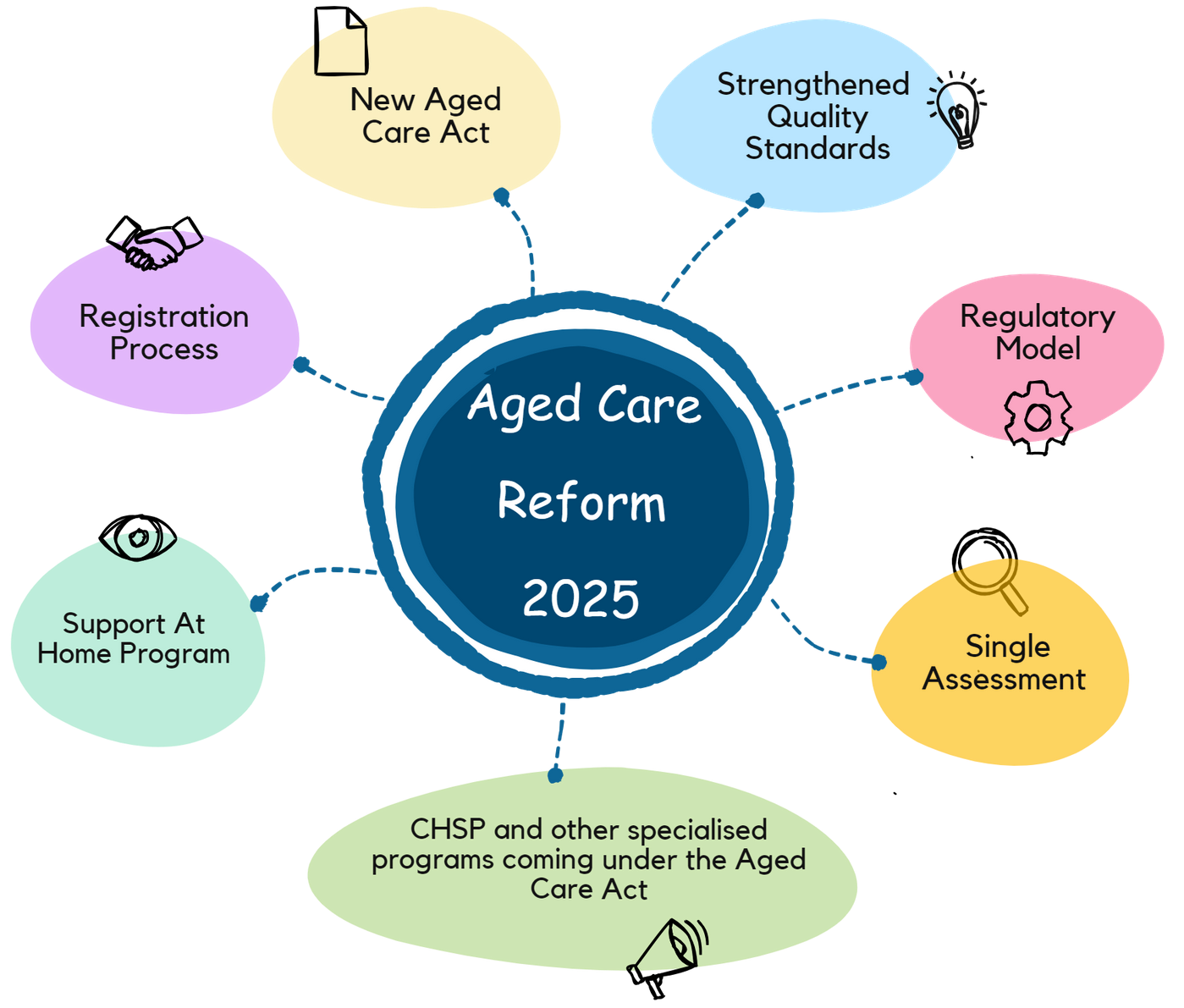
The Australian Government has rolled out the new Aged Care Act 2024 since November 1, 2025.
Therefore, we recommend checking this blog frequently for future updates. Last Updated on 1/09/2026.
The most recent amendments are listed below:
- The new provider registration model is now operating, including registration and audit processes for providers seeking Categories 4, 5 and 6.
- Support at Home classification budgets were indexed from 1 July 2026, with eight ongoing classifications and separate short-term funding pathways.
- Support at Home price caps have been deferred, and providers continue to set their own reasonable, transparent prices subject to regulatory monitoring and consumer protections.
- CHSP grant funding has been extended to 30 June 2029, and the Government has announced that CHSP should remain a standalone program rather than merge into Support at Home.
- From 1 October 2026, personal care will move to the Clinical Supports contribution category under Support at Home, meaning participants will no longer pay a contribution for approved personal care services.
Brief History of Aged Care Reforms and Why They Are Needed
The Royal Commission into Aged Care Quality and Safety was established in 2018 in response to systemic gaps identified in the aged care system, resulting in the neglect of older people and barriers to accessing quality aged care services for all who need them.
In response to the findings released in 2021, many reforms were implemented immediately, and others have been rolled out since then.
The changes that have been implemented represent the most significant improvements from the Royal Commission and put the rights of older people at the centre of care and services, holding providers to account.
New Terminology
| Term | Definition | Previously Known As |
|---|---|---|
| Aged Care Worker | Employees, contractors, and volunteers of an aged care provider | Worker, staff |
| AT-HM Scheme | Funding is available for Support at Home participants for Assistive Technology and Home Modifications. | GEAT, Goods, Equipment, Assistive Technology, Home Modifications. |
| Care Partner | A staff member who provides care management for participants with an ongoing Support at Home classification (1–8) or who is accessing the End-of-Life Pathway. | Case Manager, Care Coordinator |
| Restorative Care Partner | A staff member who provides clinical coordination and oversight for a participant on the Restorative Care Pathway. They should hold nursing or allied health qualifications, preferably at university level; other relevant clinical qualifications may also be appropriate. | Case Manager, Care Coordinator |
| Continuity of Care | An obligation on providers to support continuity of funded aged care services and manage changes or cessation of services in accordance with the Aged Care Act, Rules and applicable program requirements. | Security of tenure |
| End-of-Life Pathway | A short-term funding stream is available under Support at Home for participants who have been diagnosed with a life expectancy of 3 months or less and wish to remain at home. | Not previously provided under the Home Care Package Program |
| Funded aged care services | Aged care services funded by the Australian Government, including services funded through subsidies or Specialist Aged Care Program grants, and delivered by registered providers under the Aged Care Act 2024. | Care and services |
| Individual | A person eligible for or receiving funded aged care services | Older person, consumer |
| Integrated Assessment Tool (IAT) | The new assessment tool is used to determine an older person’s eligibility for aged care services. | National Screening Assessment Form (NSAF) |
| Participant | An individual receiving funded aged care services through the Support at Home Program. | Home care package recipient, consumer, client |
| Registered provider | A provider of funded aged care services who has been approved and registered by the Aged Care Quality and Safety Commission. | Approved provider |
| Responsible Person | A person who meets the statutory definition of a responsible person under the Aged Care Act 2024. Depending on the provider type and services, this can include executive decision-makers or governing-body members, people with significant authority or influence over the provider’s activities, the registered nurse responsible for nursing services, and the person responsible for day-to-day operations of an approved residential care home or service-delivery branch. | Key Personnel |
| Restorative Care Pathway | A short-term Support at Home pathway providing multidisciplinary, goal-focused support, primarily allied health, with around $6,000 per funding unit and up to 16 weeks per episode. A participant can access a maximum of 2 funding units in a 12-month period: either as 2 non-consecutive episodes (subject to the required waiting period) or, with assessor approval, as 2 units within one episode of up to 16 weeks. | Short-term Restorative Care, Flexible Care |
| Rules | Subordinate legislation made under the Aged Care Act 2024 that sets out detailed operational and regulatory requirements.” | Principles (Quality of Care, User Rights, Accountability, etc.) |
| Statement of Rights | The rights to which individuals are entitled are set out in Section 23 of the Aged Care Act 2024. | Charter of Aged Care Rights, the Charter |
| Strengthened Aged Care Quality Standards | The new Aged Care Quality Standards have been effective from 1 November 2025. | Aged Care Quality Standards |
| Supporter | A person or persons nominated by an individual to assist them in their decision-making. Supporters are registered with My Aged Care. | Representative, next of kin |
| Associated Provider | Any other organisation or individual person engaged to deliver funded aged care services on behalf of the registered provider. | Subcontractor or external provider. |
Key Features of the Changes on 1 November 2025
New Aged Care Act and Rules
The Aged Care Act 2024 and Aged Care Rules 2025 are now in force. The Rules are delegated/subordinate legislation made under the Act and contain detailed operational requirements that sit alongside the Act.
The new Aged Care Act 2024 contains a number of improvements on the previous Act, including:
- strengthens the rights of people accessing aged care services
- introduces enhanced system requirements for information management and complaints management
- streamlines, clarifies, and enforces the provider obligations
- introduces a new registration process and regulatory model
- introduces new supported decision-making processes
- stronger whistleblower protections for individuals, workers, and others who report breaches of Aged Care laws.
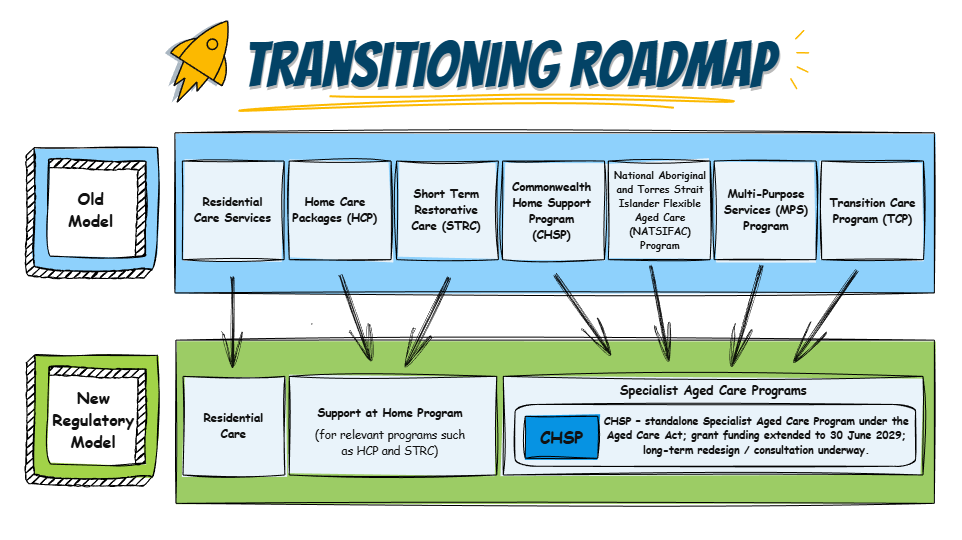
Old Aged Care Programs and the New Regulatory Model
The infographic below should now show the current regulatory model. The Commonwealth Home Support Program (CHSP) is a Specialist Aged Care Program regulated under the Aged Care Act 2024. In August 2026, the Australian Government announced that CHSP grant funding will be extended to 30 June 2029 and that the Government believes CHSP should remain a standalone program rather than being rolled into Support at Home. Consultation will inform the long-term design of a strengthened, entry-level, block-funded CHSP model and how it will integrate with Support at Home.
The other aged care programs depicted in the diagram below, which are known as Specialist Aged Care Programs from 1 November 2025, are:
- The National Aboriginal and Torres Strait Islander Flexible Aged Care (NATSIFAC) Program funds culturally safe and flexible aged care for older Aboriginal and Torres Strait Islander people, including residential, respite and community-based care. NATSIFAC continues as a Specialist Aged Care Program and is regulated under the Aged Care Act 2024 and Aged Care Rules 2025. Providers delivering NATSIFAC-funded services must also meet the applicable registered-provider requirements.
- The Multi-Purpose Services (MPS) Program provides integrated health and aged care services in rural and remote communities whose populations are too small to support separate services. It continues as a Specialist Aged Care Program under the Aged Care Act 2024 and Aged Care Rules 2025 and is not part of the Support at Home Program.
- The Transition Care Program (TCP) provides therapy-focused transition care for eligible older people after a hospital stay, generally for up to 12 weeks, with an approved extension of up to a further 6 weeks in some circumstances. It continues as a Specialist Aged Care Program under the Aged Care Act 2024 and Aged Care Rules 2025 and is not part of the Support at Home Program.
Provider Obligations and Responsibilities
Many provider obligations remain in place, while others were amended or strengthened under the Aged Care Act 2024 and Aged Care Rules 2025.
Registered providers must meet the obligations that apply to their registration categories, service types and funded programs. Depending on the services delivered, these obligations may include:
- Meet the Strengthened Aged Care Quality Standards where they apply to your registration category
- Retain an adequate number of skilled staff
- Continuous improvement
- Ensure the suitability of the Responsible Persons
- Ensure aged care workers and responsible persons meet the applicable worker screening requirements. Generally, this means a compliant police certificate that is less than 3 years old or, where applicable, a valid NDIS Worker Screening Clearance.
- Ensure all aged care workers have clearances
- Only charge certain fees and prices
- Service agreements for individuals receiving residential care or support at home
- Legislated reporting, such as Aged Care Financial Reporting, Quarterly Reports, Serious Incidents, and Material Changes.
- Provider governance arrangements
- Cooperate with the Aged Care Quality and Safety Commission
- Keeping records
- Deliver care and services consistent with the Statement of Rights
- Meet the Code of Conduct for Aged Care
- Protect personal information
- Complaints resolution and whistleblower policy
- Manage and prevent incidents
- Provide continuity of care
- Access by supporters and independent aged care advocates
The Aged Care Quality and Safety Commission has released a Provider Governance Policy that came into effect on 1 November 2025. The policy provides guidance for registered providers on the role of good governance in delivering safe, high-quality care to individuals, ensuring compliance with a provider’s responsibilities and obligations, and supporting the success and sustainability of an organisation. The policy outlines the following key aspects of provider governance:
- The Commission’s expectations of registered providers
- The guiding principles for good provider governance
- Provider governance obligations
- How the Commission collects provider governance information
- How the Commission responds to provider governance risks.
Strengthened Aged Care Quality Standards
The Aged Care Quality Standards have been strengthened under the new Aged Care Act and new regulatory model in response to the Aged Care Royal Commission, which found they did not adequately support:
- Food, nutrition, and the dining experience of older people in residential aged care
- Care of people living with dementia
- Care for people from diverse groups, notably Aboriginal and Torres Strait Islander people.
- Effective and accountable governance
- Clinical care and the management of clinical risk
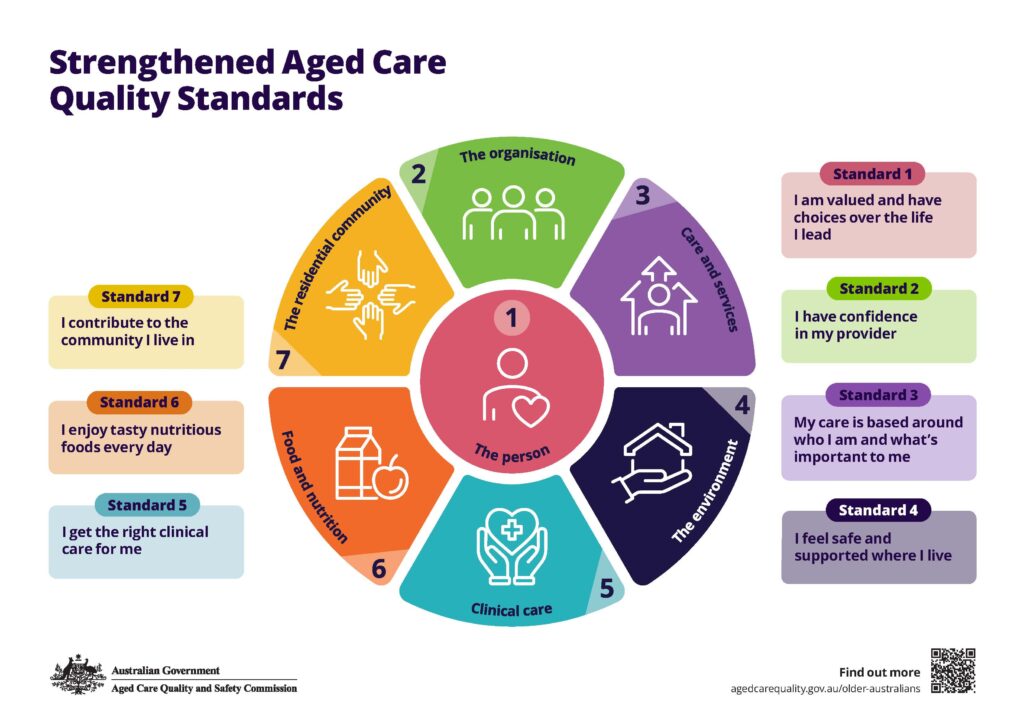
The old Aged Care Quality Standards, comprising eight standards, have been superseded by the Strengthened Aged Care Quality Standards, which combine some former requirements and introduce strengthened and new requirements.
The diagram below provides a simple overview of the Strengthened Aged Care Quality Standards.
The Strengthened Aged Care Quality Standards apply according to registration category. They do not apply to providers registered only in Categories 1, 2 and 3, although those providers remain subject to other obligations under the Aged Care Act, including the Statement of Rights and Aged Care Code of Conduct. Category 4 providers must meet Standards 1 to 4 and Outcome 5.1 Clinical Governance if they provide care management or restorative care management. Category 5 providers must meet Standards 1 to 5, and Category 6 residential care providers must meet Standards 1 to 7.
For Residential Care Providers, there is a significant strengthening of the regulation of food and nutrition to ensure that people living in residential care are provided with nutritious and tasty food, as well as an enjoyable dining experience, that meets their preferences and assessed needs, upholds their dignity, and delivers real choice.
New Regulatory Model and Registration Process
- Organisations and people that want to deliver Australian Government-funded aged care services must be registered with the Aged Care Quality and Safety Commission in the registration category or categories relevant to the services they deliver.
- Approved providers are now referred to as registered providers. The obligations that apply depend on the provider’s registration category, service types and the funded aged care programs they deliver. Some obligations apply broadly to all registered providers, while the Strengthened Aged Care Quality Standards apply only to Categories 4, 5 and 6 as described below.
- A risk-based approach to regulation, similar to that used for NDIS, is introduced; that is, the level of regulatory oversight is proportionate to the complexity of care provided.
- Universal provider registration is in place; providers that deliver services across multiple aged care programs or registration categories need only one provider registration, with all relevant categories and service types recorded under that registration.
- Registration usually lasts for 3 years. The Commission may set a shorter registration period where there is a risk that needs to be managed, and may also impose conditions on registration.
- Existing aged care and CHSP providers were transitioned (deemed) into registration categories from 1 November 2025 based on the services they delivered. Providers should now verify that their registration categories and service types remain correct and apply for a variation where their service scope changes. The former deeming-process guidance is primarily a transition reference.
Registration of New Providers
- The following entities can now apply to be registered providers:
- Companies
- Cooperatives
- Government entities
- Incorporated entities
- Other unincorporated associations with a governing body
- Sole traders
- Partnerships
- The assessment of the suitability of new organisations or people to become registered aged care providers is similar to the old provider approval process, with some terminology changes and an audit process depending on the registration categories sought.
- Prospective providers are required to complete an application form, which is different to the one previously used. The application forms are available on the Aged Care Quality and Safety Commission website.
- Applicants are assessed for suitability, experience, performance and compliance in relation to the care they currently provide, and financial viability, as well as the responses in their application.
- General requirements include:
- An organisation or person must have an ABN
- Each Responsible Person must be suitable to deliver aged care services
- Must have a record of and systems for sound financial management
- Must meet all registration category-specific requirements
- Experience in delivering aged care or similar services, such as NDIS
- Demonstrated performance in delivering services relevant to aged care, for example, outcomes of NDIS audits
- Legal and business structure, including associated entities such as subcontractors and outsourced services
- Audits against the Quality Standards are then conducted as part of the registration process for categories 4, 5, and 6 (explained in the next section), if the applicant meets the general requirements described above. Conformance demonstrated during the audit assures the Commission that the prospective provider can deliver care and services that meet the Quality Standards and reduce risk to individuals. I
- Prospective providers seeking Category 6 must have at least one residential care home approved by the Commission. The application to become a registered provider includes the application for approval of a residential care home, and the Commission can determine the home approval as part of the registration process.
Registration Categories
The six registration categories use a risk-based approach that groups service types according to complexity and risk. Registration requirements, provider obligations and regulatory oversight are therefore proportionate to the services delivered. Providers registered only in Categories 1, 2 and/or 3 are not subject to the Strengthened Aged Care Quality Standards or routine Quality Standards audits, but they must meet their other obligations under the Aged Care Act, including the Statement of Rights and Aged Care Code of Conduct. Providers registered in Categories 4, 5 and/or 6 must comply with the applicable Strengthened Aged Care Quality Standards and are audited by the Commission.
The following table summarises the way the new regulatory model is applied based on registration categories:
| Reg Category | Description | Service Types | Provider Obligations | Code of Conduct | Audit of Standards |
|---|---|---|---|---|---|
| 1 | Home & community services | Domestic assistance; Home maintenance and repairs; Meals; Transport | YES | YES | NO |
| 2 | Assistive technology & home modifications | Equipment and products; Home adjustments | YES | YES | NO |
| 3 | Advisory and support services | Hoarding and squalor assistance; Social Support and Community Engagement | YES | YES | NO |
| 4 | Person care and care support in the home and community, including respite | Allied health and therapy; Personal care; Nutrition; Therapeutic services for independent living; Home or community general respite; Community cottage respite; Care management; Restorative care management | YES | YES | YES
Standards 1–4 + 5.1 (Clinical governance) |
| 5 | Nursing and transition care | Nursing care; Assistance with transition care | YES | YES | YES
Standards 1–5 |
| 6 | Residential care, including respite | Residential accommodation; Residential everyday living; Residential non-clinical care; Residential clinical care | YES | YES | YES
Standards 1–7 |
Registration Categories Vs. Strengthened Quality Standards
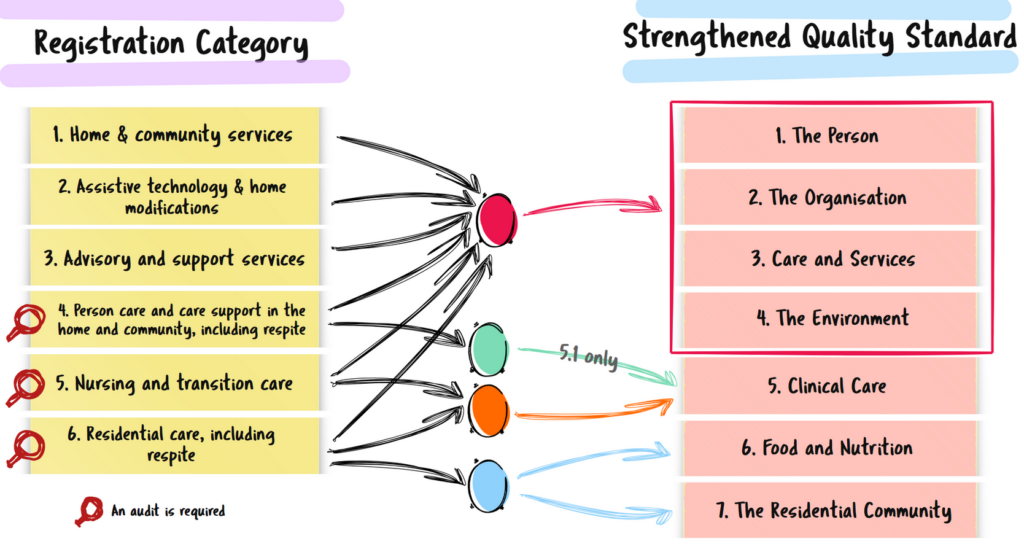
Let’s clarify one of the most common sources of confusion: how, as a provider, your registration category relates to the Strengthened Aged Care Quality Standards, and whether or not you’ll be audited.
On the left-hand side of the following picture, you’ll see the six registration categories mentioned above.
You’ll also notice the arrows connecting each registration category to different areas of the Strengthened Quality Standards. These show which standards each provider must comply with. For example, if you are registering under categories 1, 2, and 3, your application must address Standards 1 through 4. If you are registering under category 4, in addition to Standards 1 to 4, you should address Standard 5.1, which is a proportion of Standard 5.
If you provide registration category 5, you must meet Standards 1 to 5. And. In some cases, such as residential care, you need to meet all seven standards.
So, in summary, the registration category you select determines which quality standards apply to your service in addition to other requirements, such as the Code of Conduct and Provider Obligations that are applicable to all registration groups.
Now, look at the red magnifying glass icon. That means an audit is required for that registration category — so Categories 4, 5, and 6 are be audited as part of the registration process, but the registration Categories 1, 2, and 3 may be required to demonstrate compliance if their registration is ever at risk due to a serious complaint or other event.
Renewal of Registration
Registered providers are invited by the Commission to renew their registration prior to the expiry of their current registration period, and then the following steps will occur:
- Providers confirm their intention to renew their registration
- The Commission issues an audit invoice.
- For providers registered in categories 4, 5 and 6, the Commission then conducts a quality audit against the quality standards, which includes an assessment of the organisation’s governance systems, and the way care is delivered, including care experience and outcomes for individuals. The Commission has introduced a Care Delivery Evidence Collection Tool (CDECT).
- Providers apply to the Commission to renew their registration by completing an Application Form. Renewal of registration is then based on:
- information set out in the renewal application form
- the quality standards audit
- routine provider reporting
- notifications
- information from complaints
- outcomes from any risk-based monitoring or compliance actions
Single Assessment
This new system provides a single assessment pathway for individuals, including when their needs change. The Single Assessment System workforce commenced operations at the end of 2024, amalgamating three different assessment workforces: the Regional Assessment Service (RAS), the Aged Care Assessment Teams (ACAT), and AN-ACC assessors for residential care. The assessment tool now used to determine eligibility for government-subsidised aged care is the Integrated Assessment Tool (IAT).
A small number of Aboriginal and Torres Strait Islander aged care assessment organisations began a phased pilot from August 2025. The pilot provides culturally safe, trauma-aware and healing-informed aged care assessments in selected regions and is scheduled to continue to 30 June 2027, with learnings informing future rollout phases.
Statement of Rights
Under the new Aged Care Act 2024, the Charter of Aged Care Rights has been replaced with the Statement of Rights. The Statement of Rights is similar to the Charter, but the language has been strengthened to align with the rights-based new Aged Care Act, providing enhanced descriptions of each individual’s rights and clarity to aged care providers about their obligations and the consequences of breaching these rights.
A fact sheet about the Statement of Rights can be viewed at this link: A new Aged Care Act for the rights of older people
Application and Audit Fees
Under the Aged Care Act 2024, application and audit charging arrangements differ from the former approved-provider model.
The Commission charges fees to assess applications and, where applicable, to conduct audits. Providers should check the Commission’s current fee schedule before lodging an application or variation.
The Commission sets application and audit fees, which may change. Providers should check the current Registration fees page immediately before lodging an application or variation.
For current application and audit fees, use the Commission’s current Registration fees page, not the superseded August 2025 comparison table.
Key Features of the Support At Home Program
Strengthened Aged Care Quality Standards
Providers registered to deliver care and services under the new Support at Home Program are required to meet Strengthened Standards 1 to 4 and may need to meet some or all outcomes under Standard 5 if they deliver services from categories 4 and 5.
Providers registered in categories 1, 2 and/or 3 are not audited against the Strengthened Standards unless the Commission believes participants are at risk; however, providers registered in categories 4 and 5 are audited as part of the registration and renewal processes.
Existing and prospective home care providers should read this full blog to understand all the changes to aged care programs, the regulatory model, and the Strengthened Aged Care Quality Standards.
Program types
The Home Care Packages and Short-Term Restorative Care programs were replaced by Support at Home on 1 November 2025. CHSP did not transition into Support at Home. In August 2026, the Government announced that CHSP funding will continue to 30 June 2029 and that CHSP should remain a standalone program. CHSP continues as a Specialist Aged Care Program under the Aged Care Act while the Government develops its longer-term design.
Single provider model
Participants under the Support at Home Program have their services managed by a single provider, and it is a requirement that all participants receive care management.
Under the Support at Home single-provider model, the provider responsible for claiming Support at Home subsidies must be registered in Category 4 with the service type “Care management”, as well as any other service types or registration categories required for the participant’s approved services. Personal care is not a universal prerequisite. Because care management is required, the provider must also meet Outcome 5.1 Clinical Governance.
To deliver and therefore claim for nursing services, registered providers also need to be registered in Category 5.
Classification and Funding Levels
Support at Home has eight ongoing classification levels. From 1 July 2026, Classification 8 provides an annual budget of $80,137.12. Transitioned HCP Level 4 participants receive $65,415.91 annually under their transitional classification, although the two funding structures are not directly equivalent.
The table below shows the current Support at Home ongoing classification budgets effective from 1 July 2026. Funding amounts are indexed on 1 July each year.
| Class | Quarterly Budget | Annual Amount |
|---|---|---|
| 1 |
$2,752.50 |
$11,010.01 |
| 2 |
$4,112.84 |
$16,451.35 |
|
3 |
$5,634.20 |
$22,536.81 |
| 4 |
$7,617.13 |
$30,468.51 |
| 5 |
$10,182.38 |
$40,729.53 |
|
6 |
$12,341.32 |
$49,365.27 |
|
7 |
$14,915.00 |
$59,660.00 |
| 8 |
$20,034.28 |
$80,137.12 |
* Current from 1 July 2026. Support at Home classification funding amounts are normally indexed on 1 July each year. The Government has also announced an in-cycle increase from 1 October 2026 to support the aged care nurses’ award wage increase. From 1 October 2026, the quarterly subsidy amounts will be: Class 1 $2,757.89; Class 2 $4,120.89; Class 3 $5,645.23; Class 4 $7,632.04; Class 5 $10,202.32; Class 6 $12,365.48; Class 7 $14,944.20; Class 8 $20,073.50.
Additional funding streams for Assistive Technology and Home Modifications (AT-HM) would previously have been deducted from the Home Care Package budget. These tiered funding amounts are allocated based on the assessed need of the participant, that is, low, medium or high. For example, a participant with complex needs would be allocated a high tier of funding to ensure all goods and equipment required for their care can be purchased.
Participants also have access to short-term funding supports such as the Restorative Care Pathway (replacing the Short-term Restorative Care Program) and the End-of-Life Pathway (new funding). Participants accessing these pathways can also access AT-HM funding to purchase goods, equipment, or home modifications to meet their needs.
The table below outlines the expected amounts for other funding streams.
| Assistive Technology | Home Modifications | Restorative Care Pathway | End of Life Pathway |
|---|---|---|---|
|
Low – under $500 |
Low – under $500 | Around $6,000 | Around $25,000 |
| Medium – up to $2,000 | Medium – up to $2,000 | Maximum of 2 funding units in a 12-month period (around $12,000 in total): either 2 non-consecutive episodes, subject to the required waiting period, or—with assessor approval—2 units within one episode of up to 16 weeks. |
Initial budget is for 12 weeks |
|
High – up to $15,000 (or more where assessed need is evidenced) |
High – up to $15,000 | Up to 16 weeks | Remaining funds may be used up to 16 weeks; a second funding round is planned from early 2027 for eligible participants who live beyond the initial period. |
| Must be spent within 12 months | Must be spent within 12 months.
Capped at $15K over lifetime. |
Restorative care management is delivered by a restorative care partner with appropriate clinical coordination skills; nursing or allied-health qualifications are preferred, ideally at university level. |
Designed to complement state and territory palliative care services for eligible people who wish to remain at home. |
Overall, the higher classification levels (up to 8) and the additional funding streams described in the table above mean that participants of the Support at Home Program have access to high levels of funding to keep them at home for longer.
Care Domains
Under the Support at Home Program, service types are grouped into three care domains. These are also the basis of participant contribution levels, with service types supporting everyday living attracting the highest contribution level in recognition that these services – such as cleaning, home and garden maintenance, and delivery of meals – are not usually subsidised by the government at any other stage of life. The table below demonstrates this new approach:
| Category | Service Types | Participant Contribution Level* |
|---|---|---|
| Clinical Supports | Nursing; Allied health; Care management; Personal care from 1 October 2026 | 0% participant contribution – the Australian Government fully funds these services, subject to available Support at Home funding and approved services. |
| Independence | Personal care until 30 September 2026; Social support; Respite; Transport; Therapeutic services for independent living; Assistive Technology; Home Modifications | Means-tested contribution generally between 5% and 50%. From 1 October 2026, personal care moves to Clinical Supports for contribution purposes and attracts no participant contribution. |
| Everyday Living | Domestic assistance; Home and garden maintenance; Meals | Means-tested contribution generally between 17.5% and 80%. |
* Participant contribution arrangements are in force. Clinical Supports attract no participant contribution; Independence services generally attract means-tested contributions between 5% and 50%; and Everyday Living services generally attract means-tested contributions between 17.5% and 80%. “No worse off” arrangements apply to eligible grandfathered participants. From 1 October 2026, personal care moves to the Clinical Supports contribution category and will no longer attract a participant contribution.
Capped Pricing
The Australian Government announced in May 2026 that Support at Home price caps would be deferred until there is greater confidence in market stability. There is currently no new commencement date for those caps.
Providers currently set their own Support at Home prices. Prices must be reasonable, transparent and reflect the full cost of delivering the service. Providers must publish their most frequently charged prices on their website and My Aged Care, and pricing is subject to monitoring and regulatory action. The former indicative price ranges should not be presented as price caps or recommended prices.
Current Support at Home pricing requirements
Providers should ensure Support at Home service agreements, care plans, individualised budgets and monthly statements remain current and accurately reflect agreed services, prices and participant contributions. The Support at Home Program Manual and related Department guidance set out current operational requirements.
CHSP continues to use national unit price ranges with annual indexation and applicable price-loading arrangements. Providers should use the latest CHSP Manual, service catalogue and Department guidance for current pricing and claiming requirements.
Care Management
- Care management is classified under the Clinical Supports care domain.
- Care management funding is now capped at 10% of the participant’s quarterly budget. Services Australia deducts this and keeps it in a pooled care management account.
- Providers can use the funding in that account flexibly for any of their participants, accessing it by claiming for care management activities for ongoing services.
- Care management is undertaken by suitably qualified Care Partners who must deliver a care management activity at least monthly.
- There are no mandatory qualifications or registrations for an ordinary Support at Home care partner. Providers must ensure care partners are appropriately trained and experienced and should design their care-management workforce to meet participant needs, including access to clinically-qualified care partners where clinical complexity requires it.
- Restorative care partners provide clinical coordination and oversight for the Restorative Care Pathway. Current guidance says they should hold qualifications in nursing or allied health, preferably at university level so they can work autonomously; other relevant clinical qualifications may also be appropriate. They are not limited to AHPRA-registered nurses or allied health professionals in every case.
Package Management
Package management is no longer a separate billable service type, and the costs that were previously covered by this fee under the Home Care Package Program are now expected to be incorporated into service pricing (see information under Capped pricing).
Supported Decision Making Framework
Supported decision-making involves helping an individual (previously referred to as consumer or older person), make or communicate their own decisions, thereby maintaining control over their lives.
A key feature of the new Act is the presumption that every individual has the ability to make decisions, and recognition that some may want or need support to make those decisions.
Under the new Act, individuals can choose who can support them in making decisions, when and if they want or need support, and these people are known as registered supporters.
Registered supporters can be individuals who also hold a guardianship or power of attorney role, or they can be trusted family members or friends. The difference is that a registered supporter who is not a guardian or power of attorney does not have decision-making power on behalf of the individual; their role is to support the individual to make their own decisions.
The registered support role replaces the roles of regular and authorised representatives in My Aged Care.
More details about this important change are available in the Australian Government Department of Health, Disability and Ageing guidance on supported decision-making and registered supporters
Financial and Prudential Standards
The current Financial and Prudential Standards have applied since 1 November 2025. They strengthen financial governance and provider sustainability and replace the former Prudential Standards framework. Depending on the provider type and registration category, the Financial and Prudential Management, Liquidity and Investment Standards may apply.
The changes are summarised as follows:
- The new Financial and Prudential Management Standard replaces the old Governance Standard.
- The Liquidity Standard remains but has been strengthened.
- The Investment Standard is new and ensures residential care providers manage and monitor investments responsibly, including those made with refundable accommodation deposits.
- The former Disclosure and Records Prudential Standards have not continued as separate Financial and Prudential Standards. Relevant disclosure, record-keeping and information obligations now sit within the Aged Care Act 2024, Aged Care Rules 2025 and associated provider obligations, which are in force.
| Old Standards | New Standards |
|---|---|
| Governance Standard | Financial and Prudential Management Standard |
| Liquidity Standard | Liquidity Standard (Strengthened) |
| Disclosure | Relevant disclosure obligations are contained in the Aged Care Act 2024, Aged Care Rules 2025 and provider reporting requirements. |
| Records | Relevant record-keeping obligations are contained in the Aged Care Act 2024, Aged Care Rules 2025 and applicable provider requirements. |
| Investment Standard |
The current Financial and Prudential Standards and the provider types they apply to are as follows:
| Standards | Who it applies to |
|---|---|
| Financial and Prudential Management Standard | Non-government providers registered in Categories 4, 5 or 6; non-government Multi-Purpose Service providers; and NATSIFAC providers. Does not apply to government or local government authority providers. |
| Liquidity Standard | Category 6 providers delivering funded aged care in an approved residential care home, excluding government entities, local government authorities and NATSIFAC providers. Applies even if no refundable deposits are held. |
| Investment Standard | Category 6 providers delivering funded aged care in an approved residential care home, excluding government entities, local government authorities and NATSIFAC providers. Applies even if no refundable deposits are held. |
*Excluding government entities and local government authorities.
More information is available here: The new Financial and Prudential Standards.
Aged Care Data and Digital Strategy 2024–2029
The Australian Government’s Aged Care Data and Digital Strategy 2024–2029, as a key component of the broader Aged Care Reform, outlines a transformative vision for aged care, emphasising person-centred services, streamlined operations, and enhanced digital capabilities. To thrive in this evolving landscape, aged care providers must adopt innovative solutions that align with these strategic priorities.
Key Strategic Priorities:
-
Enhancing Digital Maturity: Building and embedding data and digital maturity across the sector to support efficient, high-quality care.
-
Optimising Data Utilisation: Improving data collection and utilisation to inform better decision-making and service delivery.
-
Strengthening Care Connections: Integrating aged care support plans with My Health Record to ensure coordinated and continuous care.
-
Reducing Administrative Burden: Automating data sharing between providers and the government through initiatives like the Business to Government (B2G) developer portal.
What can Existing Registered Providers Expect?
Home Care Providers
- Existing providers were transitioned into the new registration model from 1 November 2025. Providers should now confirm that their registration categories and service types remain appropriate and apply for a variation if they intend to add services or categories.
- You should immediately familiarise yourself with the Support at Home Program Manual and associated resources. See key resources at the Links to Key Resources.
- Support at Home commenced on 1 November 2025. Existing providers should now focus on ongoing compliance, accurate claims and pricing, current service agreements, care planning, participant statements, workforce capability and any registration variations needed for the services they deliver.
- For current operational requirements, providers should use the latest Support at Home Program Manual and the Department’s Support at Home resource hub. The Provider Transition Guide remains useful for any outstanding legacy transition activities.
- The current Support at Home Program Manual provides the principal operational guidance for registered providers, including care management, service delivery, budgets, contributions, claims and the short-term pathways.
- Grandfathering arrangements apply to home care package recipients who, as of September 12, 2024, were either receiving a Home Care Package through the National Priority System or had been assessed as eligible for one. These arrangements ensure that grandfathered HCP recipients won’t face reduced support or higher costs under the new Support at Home contribution rules. Details on grandfathering arrangements are available in the Support at Home Program Manual.
Flexible Care Providers
- The Short-Term Restorative Care Programme was replaced by the Restorative Care Pathway when Support at Home commenced on 1 November 2025.
- Existing providers were transitioned into the new registration model from 1 November 2025. Providers should now confirm that their registration categories and service types remain appropriate and apply for a variation if they intend to add services or categories.
- You should immediately familiarise yourself with the Support at Home Program Manual and associated resources. See key resources at the Links to Key Resources.
- The Restorative Care Pathway is now operating under Support at Home. It retains a multidisciplinary, goal-focused approach but has different funding, claiming, care-management and registration requirements from the former STRC Program. Providers delivering the pathway should ensure they are registered in Category 4 for both “Restorative care management” and “Allied health and therapy” and meet the applicable clinical governance requirements.
- Providers should use the current Support at Home Program Manual and Restorative Care Pathway guidance for the latest operational requirements.
- The Department has now published detailed Restorative Care Pathway guidance and the current Support at Home Program Manual. Providers should use the latest online versions because operational guidance continues to be updated.
Residential Care Providers
Major residential aged care reforms commenced on 1 November 2025. Existing providers should now be operating under the new Act and current fee, accommodation, quality and reporting arrangements, including the following:
- Registered residential care providers must report changes to operational/offline beds in accordance with the Aged Care Rules. Since 23 March 2026, providers can manage offline beds through GPMS. Providers must also submit 24/7 Registered Nurse coverage reports for each residential care home each calendar month, including where an exemption applies.
- Places are no longer allocated to residential care providers but are assigned directly to individuals who access government-funded residential care services; therefore, mainstream residential care providers no longer need an allocation of places to deliver government-funded aged care services.
- Providers who provide specialist aged care programs, such as Transition Care, still need to be allocated places. More information on the Places to People changes can be viewed at: Places to people – Embedding choice in residential aged care.
- The Higher Everyday Living Fee (HELF) commenced on 1 November 2025. It is optional and applies where a resident chooses services above the standard services the aged care home is required to provide. New additional and extra service fee arrangements can no longer be entered into. Existing additional or extra service fee arrangements entered into before 1 November 2025 may continue only until 31 October 2026; after that, relevant optional services need to be provided under HELF arrangements.
- Changes to accommodation funding, including:
- The maximum accommodation payment amount was initially increased from $550,000 to $750,000 and is now indexed annually. From 1 July 2026 to 30 June 2027, the maximum amount that can be published without IHACPA approval is $789,686.
- For eligible residents under the 1 November 2025 accommodation arrangements, RAD/RAC retention is calculated daily at the legislated rate of 2% per annum. Retention must be deducted regularly, at least once in each 3-month period and no more than once in a month, and it is limited to the first 5 years in care.
- Daily Accommodation Payment (DAP) amounts are indexed twice each year, on 20 March and 20 September.
CHSP Providers
Since 1 November 2025, CHSP providers have been subject to the Aged Care Act 2024 and the current provider-registration and regulatory framework applicable to their registered services.
From 1 November 2025, CHSP providers became registered providers under the new regulatory model and were deemed into applicable registration categories and service types. For example, domestic assistance and home maintenance sit in Category 1, while personal care sits in Category 4. CHSP is a Specialist Aged Care Program regulated under the Aged Care Act 2024.
CHSP providers must also comply with the new Aged Care Act, including meeting provider obligations relating to the following:
- The Code of Conduct for Aged Care
- Worker screening requirements
- Personal information and record keeping
- Fees and payments
- Incident management and reporting under the Serious Incident Response Scheme
- Continuity of Care (known as security of tenure)
- Service planning
- Complaints and whistleblowers
- Statement of Rights and Statement of Principles
- Compliance with laws and regulations
More details can be viewed at this link: The new regulatory model: Guidance for CHSP providers
CHSP providers now report service-delivery data monthly through the Data Exchange (DEX) against the current CHSP service list and reporting requirements, including My Aged Care identifiers where required. Providers should use the latest CHSP Manual, DEX Data Exchange Dictionary and DEX provider toolkit for current data fields, timing and system requirements.
Current DEX reporting resources, including the Data Exchange Dictionary and DEX provider toolkit, are available through the Department’s CHSP resources page.
CHSP service descriptions and regulatory requirements changed from 1 November 2025 under the Aged Care Act and the 2025–27 CHSP arrangements. Providers should use the current CHSP service catalogue and Manual for service names, inclusions, exclusions and delivery requirements. CHSP remains separate from Support at Home, although the Government intends the two programs to work together more seamlessly.
The current Commonwealth Home Support Program service catalogue 2025–27 and CHSP Manual should be used instead of the earlier “proposed changes” fact sheet.
For current CHSP requirements and future reform announcements, refer to the Department of Health, Disability and Ageing CHSP reforms page and the latest CHSP Manual.
Commonwealth Home Support Program (CHSP) reforms and 2025–27 Manual
CHSP future – important August 2026 update
IMPORTANT CHSP UPDATE – August 2026: The Australian Government has extended CHSP grant funding for a further two years to 30 June 2029. More importantly, the Government has stated that it believes CHSP should remain a standalone program rather than being rolled into Support at Home. The extension to 2029 is therefore not a new merger date. The Government will consult on the long-term design of a strengthened entry-level program, including continuation of block funding, fair and equitable client contributions, early intervention and better integration with Support at Home.
Current CHSP client contribution arrangements continue under the CHSP framework. However, the Government has identified future contribution settings as one of the matters to be considered in consultation on the long-term CHSP model, so providers should monitor future announcements.
How Can I Ensure I Deliver High-Quality Care to Individuals?
- Engage qualified, competent, suitable workers
- Stay up-to-date with regulatory changes
- Listen to your clients and workers
- Monitor risks, incidents, and complaints
- Undertake regular Self-assessments and internal audits
- Comply with the Strengthened Aged Care Quality Standards where they apply to your registration category, and meet all other applicable provider obligations under the Aged Care Act and Rules.
- Follow the quarterly Sector Performance Reports issued by the Commission, ACQSC Sector Performance.
How Can I Stay Up-to-Date?
- Tune into this blog
- Consider resources available through ISO Consulting Services, which consistently align with the most recent legislative changes and best practices.
- Stay connected with the resources listed in the Sections for links to key resources for the most current information
- Subscribe to updates from:
- Department of Health, Disability and Ageing – Aged care newsletters and alerts
- Aged Care Quality and Safety Commission – Subscribe to ACQSC bulletins
How Can I Prepare to Meet the Strengthened Aged Care Quality Standards?
Existing Providers
Existing providers should understand which Strengthened Aged Care Quality Standards apply to their registration categories and how they must demonstrate ongoing compliance.
If you are an existing registered provider delivering CHSP, Support at Home, residential care or another funded aged care program, the key ongoing compliance steps include:
- Ensure you understand the Strengthened Aged Care Quality Standards and how they differ from the old standards.
- Access the Strengthened Quality Standards Provider Guidance to assist your preparation, to understand what quality care looks like to individuals receiving it, and to comply with quality audits when they occur: Strengthened Quality Standards – Provider Guidance
- Ensure workers are trained in the applicable Strengthened Aged Care Quality Standards and keep that training current.
- Undertake regular self-assessments against the applicable Strengthened Aged Care Quality Standards (you can contact us to enquire about the FREE Gap Assessment Tool, offered as part of ISO+™ – an all-in-one aged care compliance and operations software).
- Develop and implement corrective actions to resolve any gaps identified in the above self-assessment.
- Review and update your policies and procedures to ensure they continue to meet or exceed the applicable Strengthened Aged Care Quality Standards.
- Review your processes and systems to ensure they continue to support compliance with the applicable Strengthened Aged Care Quality Standards.
The Commission now uses final Audit Evidence Collection Tools (AECTs) as part of registration, renewal and variation audits. Providers renewing registration must also complete the Care Delivery Evidence Collection Tool (CDECT) so the Commission can assess how systems and processes are embedded in service delivery.
The Commission uses the final Audit Evidence Collection Tools (AECTs) for relevant registration, renewal and variation audits involving Categories 4, 5 and 6. For renewal audits, CDECT is used where applicable: the Commission identifies targeted care-delivery locations for Categories 4 and 5, while the Category 6 Residential CDECT must be completed once for each Category 6 service.
For renewal audits, AECT – Renewal collects provider-level evidence about systems and processes. CDECT collects service-delivery evidence at the locations or residential services selected under the Commission’s audit approach.
- Draft Audit Evidence Collection Tool – Registration Renewal
- Draft Audit Evidence Collection Tool – Registration Variation
- Care Delivery Evidence Collection Tool (CDECT) – Care delivery location (Category 4 & 5)
- Care Delivery Evidence Collection Tool (CDECT) – Residential (Category 6)
New Providers
Prospective providers should understand which Strengthened Aged Care Quality Standards apply to their proposed registration categories and how they will demonstrate compliance during registration and audit.
If you apply to become a new registered provider in Categories 4, 5 or 6, the Commission will audit you against the applicable Strengthened Aged Care Quality Standards as part of the registration process. You must therefore be able to demonstrate that your planned systems and processes can conform with the relevant Standards before registration is granted. The Strengthened Quality Standards do not apply to providers registered only in Categories 1, 2 or 3, although those providers must meet their other obligations under the Aged Care Act.
We recommend taking the following steps prior to submitting your application for registration:
- Ensure you understand the Strengthened Aged Care Quality Standards.
- Access the Strengthened Quality Standards Provider Guidance to assist your preparation, to understand what quality care looks like to individuals receiving it, and to prepare evidence in readiness for your quality audit: Strengthened Quality Standards – Provider Guidance
- Ensure workers are trained in the applicable Strengthened Aged Care Quality Standards and keep that training current.
- Undertake regular self-assessments against the applicable Strengthened Aged Care Quality Standards
- Develop and implement corrective actions to resolve any gaps identified in the above self-assessment.
- Develop policies and procedures that meet or exceed the applicable Strengthened Aged Care Quality Standards.
- Develop or select processes and systems that support compliance with the applicable Strengthened Aged Care Quality Standards.
We recommend that you use the following checklist to prepare your organisation and your workers to meet the Strengthened Aged Care Quality Standards: Provider Readiness Checklist.
The Commission’s Audit Evidence Collection Tool (AECT) – Registration is now the compulsory evidence collection tool for initial registration audits involving Categories 4, 5 and 6.
Audit Evidence Collection Tool (AECT) – Registration
How ISO Consulting Services Can Help
At ISO Consulting Services, we work with Aged Care providers across Australia to stay ahead of pricing changes, maintain compliance, and prepare for audits with confidence. Whether you need help interpreting the SaH and CHSP requirements or updating your documentation. We can also assess your readiness against the SaH and CHSP requirements, identify evidence gaps, and support registration and audit preparation.
Our ISO+™ NDIS platform provides an all-in-one compliance management system built specifically for NDIS providers, with linked policies, registers, incident tracking, audit tools, and real-time visibility across your operations.
Don’t let outdated policies, systems or audit evidence place your aged care registration at risk. Request a free aged care readiness consultation with ISO Consulting Services and take the next step towards meeting the Strengthened Aged Care Quality Standards.
Links to Key Resources
Department of Health and Aged Care
- Aged Care Act 2024 – current information and resources
- Aged care reform resources for providers
- New regulatory model and provider registration guidance
- Provider Handbook – current provider requirements and quality obligations
- Department of Health, Disability and Ageing – Residential aged care
Support At Home Program
Commonwealth Home Support Program
- CHSP Reforms
- The new regulatory model: Guidance for CHSP providers
- CHSP extended to 30 June 2029 – official August 2026 announcement
- Commonwealth Home Support Program (CHSP) 2025–27 Manual
Aged Care Quality and Safety Commission Resources
- Reform Changes for Providers
- Provider Registration Policy
- Provider Handbook – Aged Care Quality and Safety Commission
- Provider Handbook and current Commission reform guidance
- Commission Sector Webinars
Strengthened Aged Care Quality Standards
- ACQSC – Strengthened Aged Care Quality Standards
- Strengthened Aged Care Quality Standards – provider training presentation
- Strengthened Quality Standards – Provider Guidance
Financial and Prudential Standards




Our expertise is to help our clients develop, implement, certify and maintain their management system through a hassle-free process and with a…
Read More
The National Disability Insurance Scheme (NDIS) provides about 460,000 Australians under the age of 65 with a permanent and significant disability with…
Read More
As the aged population is growing in Australia, the need for a range of care, accommodation, hospitality, and other services is undeniable. To address this growth…
Read More